
At 6:00 p.m., the last patient has left, the lights in the clinic are half off, and the inbox is still full of portal messages, refill requests, referral follow-ups, and prior authorization forms. That's the moment many practices start looking for a medical virtual assistant, because the work didn't end when the schedule did. It just moved to the back office.
A good hire medical virtual assistant decision is not about finding someone who can “help with admin.” It's about assigning structured work to a remote team member who can handle scheduling, insurance verification, documentation support, patient communication, and telehealth logistics without crossing into licensed clinical judgment. The administrative load is real, physicians reported 57.8 hours worked per week in 2024, with only 27.2 hours devoted to direct patient care, while 20.3 hours went to indirect-care and administrative work, or about 35.1% of the workweek, according to AMA data AMA physician work and EHR time data.
That's why this role deserves a serious hiring process, not a rushed search. The practices that get this right define the scope tightly, control access before the first login, screen with a real workflow simulation, and measure whether the assistant gives clinician time back. The ones that get it wrong buy cheap labor, skip controls, and end up with rework, escalation chaos, or access risk.
Introduction
A clinic feels the strain fastest at the front desk and in the inbox. Messages stack up, prior authorizations wait, and scheduling gaps turn into after-hours cleanup. That is the point where a medical virtual assistant stops being a convenience hire and becomes a staffing decision.
A medical virtual assistant is a remote operations partner for repetitive, structured healthcare tasks. Typical work includes appointment scheduling, insurance verification, EHR data entry, inbox triage, referral coordination, patient follow-up communication, and telehealth admin. It is not a substitute for a licensed clinician, and it should never drift into diagnosis, prescribing, or independent triage unless the role, supervision, licensure, and escalation rules clearly allow it.
The pressure is already there. AMA data shows physicians are still carrying a substantial amount of indirect and administrative work, and some are taking EHR work home after hours AMA physician work and EHR time data. A remote assistant will not reduce patient demand, but it can remove repeatable work that does not need a license and often crowds out clinician time.
One practical rule holds up in real offices: if a task can be defined, repeated, audited, and escalated, it belongs on the delegation list.
The hiring decision should follow that logic. A solid hire medical virtual assistant process covers role definition, privacy controls, sourcing, screening, pricing, onboarding, and performance measurement. The key question is whether the setup holds up after week one, with the right access limits, clear handoffs, and proof that the assistant is giving time back instead of creating rework.
Defining the Medical VA Role and Task Scope
The job post comes last. The task inventory comes first. That order matters because “medical VA” can mean very different things from one practice to another, and a vague role almost always produces scope creep.
Break the work into task clusters
The cleanest way to define the role is by recurring workflow. In most practices, that means six clusters: billing and insurance verification, EHR documentation support, appointment scheduling and reminders, patient communication and portal triage, referral coordination, and telehealth logistics. Each cluster has a different access profile, and that profile drives training, supervision, and whether the assistant touches ePHI.
Some tasks are straightforward administrative ownership. Scheduling, reminder outreach, referral packet routing, and insurance eligibility checks are often good fits when the process is standardized. Other tasks need tighter guardrails. Inbox triage, refill intake, and documentation support may be safe only when the assistant follows a written escalation tree and never makes independent clinical decisions.
The mistake I see most often is hiring for a title instead of a workflow. Once you do that, the role starts expanding from “message routing” to “anything the front desk can't finish.”
Use a one-page scope statement that names the exact duties and the exact boundaries. A workable draft is below.
Scope of work skeleton
- Primary duties: scheduling, reminder calls or messages, insurance verification, referral tracking, inbox triage, documentation support, and telehealth coordination.
- Excluded duties: diagnosis, prescribing, clinical triage without escalation, and any activity reserved for licensed staff.
- Access limits: minimum-necessary access to named systems only.
- Escalation rule: anything clinical, ambiguous, urgent, or outside protocol goes to licensed staff immediately.
Map ePHI exposure before you write the role
Once the tasks are listed, classify which ones expose electronic protected health information. That classification matters because it determines whether you need a business associate agreement, what access the assistant gets, what the device controls look like, and how you test the candidate before access begins.
| Medical VA Task Clusters by Risk Level | ePHI Exposure | Example Duties | Required Controls |
|---|---|---|---|
| Scheduling and reminders | Low to moderate | Book visits, confirm appointments, send reminders | Named account, minimum-necessary access, logging |
| Insurance and referral coordination | Moderate | Eligibility checks, prior auth intake, referral tracking | Role-based permissions, audit trail, escalation rules |
| Inbox triage and follow-up | Moderate to high | Route portal messages, flag urgent items, track responses | Supervised workflow, documented decision rules, training |
| Documentation support | High | Draft notes, organize encounter-related records | Tight access controls, review process, audit logging |
| Telehealth logistics | Moderate to high | Visit setup, platform coordination, patient instructions | Secure devices, MFA, device policy, BAA where applicable |
That table should become the backbone of the job post. If a task doesn't appear in it, it probably doesn't belong in the role yet.
HIPAA and Pre-Access Compliance Checks
A rushed hire can create a bigger problem than an empty inbox. Before a medical VA touches patient systems, the practice needs proof that access is scoped, controlled, and removable.
Build the pre-access control model
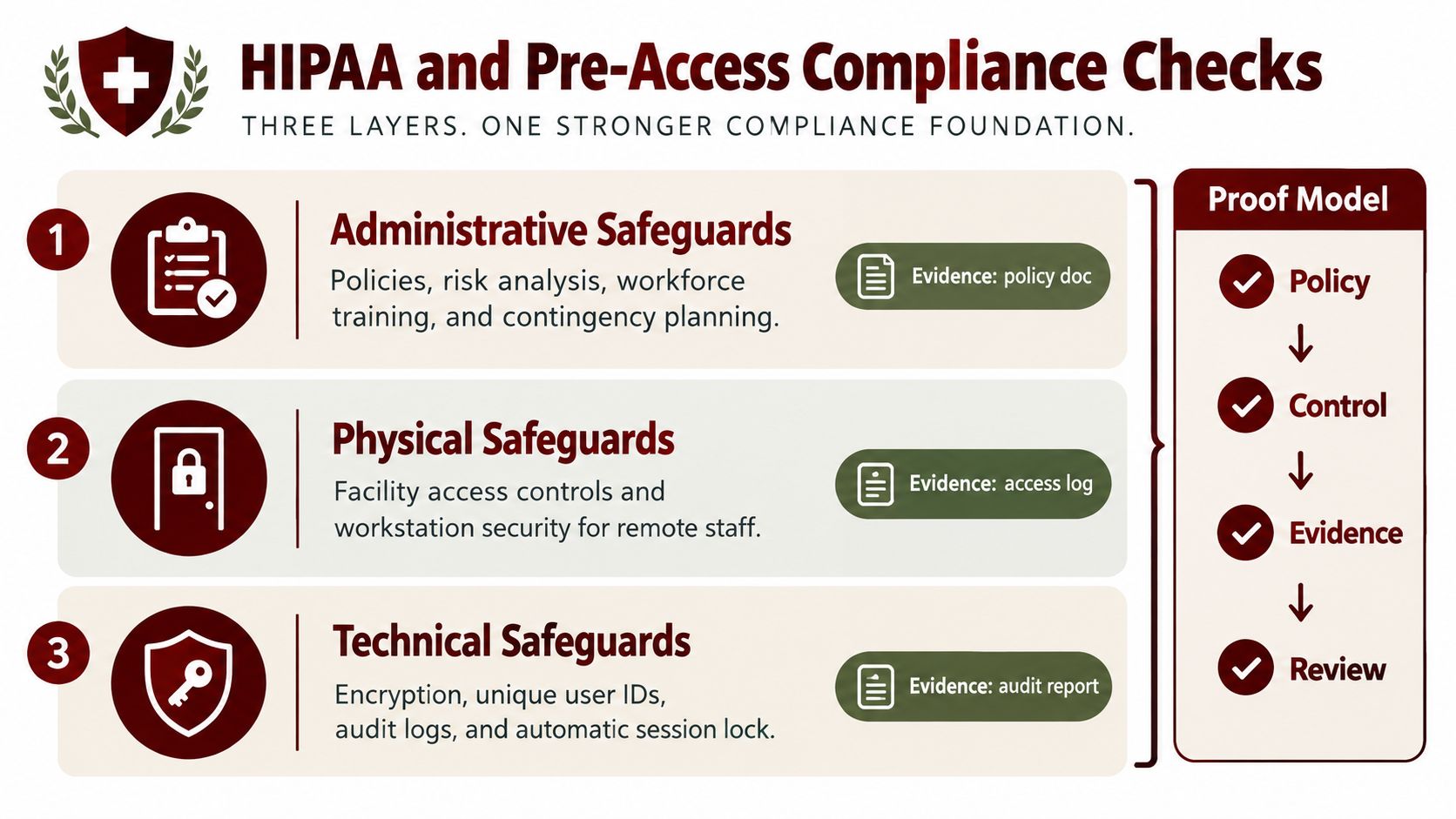
The HHS Security Rule guidance requires administrative, physical, and technical safeguards for ePHI. That is a control problem, not a checkbox. In practice, a medical VA should not get system access until the practice has verified who they are, what they can see, where they will work, and how access will be revoked.
Start with named accounts instead of shared logins. Set least-privilege permissions so the VA can do assigned work only, not browse the full chart. Require multifactor authentication, confirm the device and network meet your standards, turn on audit logging, and document incident response plus offboarding before the first login. If a third-party provider will touch ePHI, the agreement and safeguards need to be in place before access begins.
Remote and telehealth vendors need the same discipline. A VA may be well trained, but weak system controls still create exposure.
Ask for evidence, not promises
A candidate or agency should be able to show proof, not just speak confidently about compliance. Ask for written training records, device standards, incident reporting steps, and offboarding procedures. If you are using an outside vendor, confirm who revokes access, when the business associate agreement is signed, and how quickly account removal happens after the contract ends.
Practical rule: if access cannot be removed the same day the relationship ends, the setup is not ready.
Compliance interviews should test judgment, not memory. Ask how they handle shared devices, how they apply minimum-necessary access, and what they do when an urgent message is ambiguous. For practices that use workflow controls around data access, Octowatch DLP reflects the same operating idea, prove control before trust.
A simple pre-access checklist keeps the process disciplined:
- Named accounts: no shared credentials or generic logins.
- Permission review: only the tasks assigned in writing.
- Security review: device, browser, MFA, and network expectations confirmed.
- Training proof: written evidence of role-specific privacy and escalation training.
- BAA in place: signed before the first system login.
- Offboarding proof: immediate access removal steps documented.
If a task cannot pass this checklist, it should stay out of the role until the controls are in place.
How LatHire Can Help

When practices want to hire faster without giving up screening discipline, a platform like LatHire can help by centralizing sourcing, pre-vetting, and cross-border hiring support. Its main value here is not that it magically solves medical compliance, it's that it reduces the mess around recruiting, especially when you need a remote operations hire and don't want to start from a blank inbox.
The useful part is the workflow. You can take an existing job description, line it up against skills filters, and then interview from a better candidate pool instead of sorting through unqualified generalists. If you need a resource for broader talent sourcing, the page for hire medical virtual assistants is a practical starting point.
For practices seeking healthcare-focused support, MedicalVirtual.com specialises in remote medical assistants for workflows such as appointment scheduling, patient intake, and administrative follow-up. This focus is relevant when the role requires familiarity with medical terminology, patient communication, and the daily routines of a busy practice. Practices evaluating candidates should confirm experience with their EHR, coverage during office hours, and readiness to follow their privacy and escalation procedures.
Where it fits and where it doesn't
LatHire makes sense when you need a hiring pipeline, pre-vetting, and support around international recruitment. It's a decent fit for practices that want to move quickly but still keep control over interview questions, simulated testing, and final access approval. It's less useful if you're looking for a turnkey medical staffing model that includes healthcare-specific compliance management out of the box.
Compared with a freelance marketplace, the better question is whether the platform helps you evaluate the assistant as an operator, not just a résumé. Compared with a specialty medical VA service, the question is whether you're willing to own the compliance architecture yourself. For practices that already have a strong manager and a defined workflow, that trade-off can work well.
The right decision comes down to the same rule used everywhere else in this article. Pick the channel that supports the controls you will enforce, not the one that merely looks cheapest at first glance.
Sourcing Channels and Screening Candidates
The sourcing channel changes your risk more than most buyers expect. A general freelance platform, a healthcare staffing agency, and a niche medical VA service all promise help, but they don't give you the same level of vetting or replacement support.
Compare the channels honestly
General freelance platforms are usually the lowest-friction option, but the buyer owns almost everything after hire. Healthcare staffing agencies reduce recruiting burden, but compliance coverage can still be uneven. Niche medical VA services tend to be the strongest fit when the role touches ePHI, because they're built around healthcare workflows rather than generic admin support.
| Sourcing Channel | Typical Hourly Rate | Included Vetting | Hidden Cost Factors |
|---|---|---|---|
| General freelance platforms | Lower end of the market | Self-reported skills and buyer-run screening | Training time, compliance setup, replacement risk |
| Healthcare staffing agencies | Mid-range | Some healthcare screening and managed placement | Supervision time, QA, replacement handling |
| Niche medical VA services | Higher, but more structured | Workflow testing, healthcare familiarity, tighter compliance posture | Less price flexibility, often more process discipline |
Hourly price alone hides the full cost. Supervision time, EHR training, quality assurance, time-zone handoffs, replacement hiring, and error rework can easily outweigh the apparent savings. That's why the lowest quote is often the most expensive hire in practice.
Use interview scripts that test work, not slogans
Skip the warm-up question, “Are you HIPAA trained?” Ask what they've done. Have them walk through a prior authorization intake, a portal message triage, or a referral packet with missing information. Ask what they would escalate, what they would document, and what they would never answer on their own.
A strong screening script includes:
- EHR familiarity: which systems they've used and what they did inside them.
- Escalation judgment: what triggers a handoff to licensed staff.
- Prior authorization workflow: how they track missing documentation and deadlines.
- Minimum-necessary discipline: how they avoid opening more data than the task requires.
- Reference validation: whether former supervisors would describe them as accurate, dependable, and careful with sensitive information.
The most practical test is a 30 to 60 minute simulated queue. Give the candidate a mixed inbox containing portal messages, refill requests, appointment changes, and referral items. Score them on data-entry accuracy, escalation decisions, turnaround time, and minimum-necessary access discipline. That test tells you more than a polished interview ever will.
If you want a structured hiring workflow to plug this into, InterviewKit is a useful reference point for building a repeatable interview process.
Practical rule: if the candidate looks great in conversation but can't process a messy queue cleanly, they're not ready for live patient workflows.
Pricing Benchmarks and Contract Essentials
The market for medical virtual assistants includes hourly staffing models and fully managed service models, and the number you see first is usually not the number that matters most.
Build the real cost picture
Available guidance places agency-managed healthcare VA rates roughly between $8 and $25 per hour, while another estimate puts qualified healthcare VAs at $8 to $15 per hour and claims they can cost 50% to 70% less than equivalent in-house staff. Those figures are directionally useful, but they're incomplete because they leave out supervision, EHR training, quality assurance, downtime, replacement hiring, and the cost of errors in referrals, prior authorizations, scheduling, or billing Healthcare VA outsourcing guide.
The smarter model is workload-based. Measure how many completed tasks per hour you need, how many clinician hours the assistant returns, and whether the hire improves appointment conversion, no-show handling, authorization turnaround, and first-contact resolution. If those numbers improve, the hire is helping economics. If they don't, the hourly rate doesn't matter much.
A cheap assistant who creates rework is not cheap. They're just billed differently.
Put the contract around the workflow
The contract should cover more than payment terms. Define the exact scope, the systems the assistant can access, how patient data is handled, who owns offboarding, and what happens if the assistant violates access rules. The agreement should also make it clear that the assistant stays within the assigned workflow and doesn't step into areas reserved for licensed staff.
A solid contract checklist includes:
- Scope definitions: named workflows, excluded tasks, and escalation rules.
- Data-handling clauses: minimum-necessary access, secure storage, and communication rules.
- BAA language: signed before access starts when ePHI is involved.
- Termination terms: immediate access removal and return or deletion of practice data.
- Payment structure: hourly, retainer, or managed-service pricing tied to defined coverage.
If you're deciding between price points, don't ask which is cheapest. Ask which structure creates the fewest hidden hours for your team. A practice manager's time is part of the true cost.
Onboarding and Performance Measurement
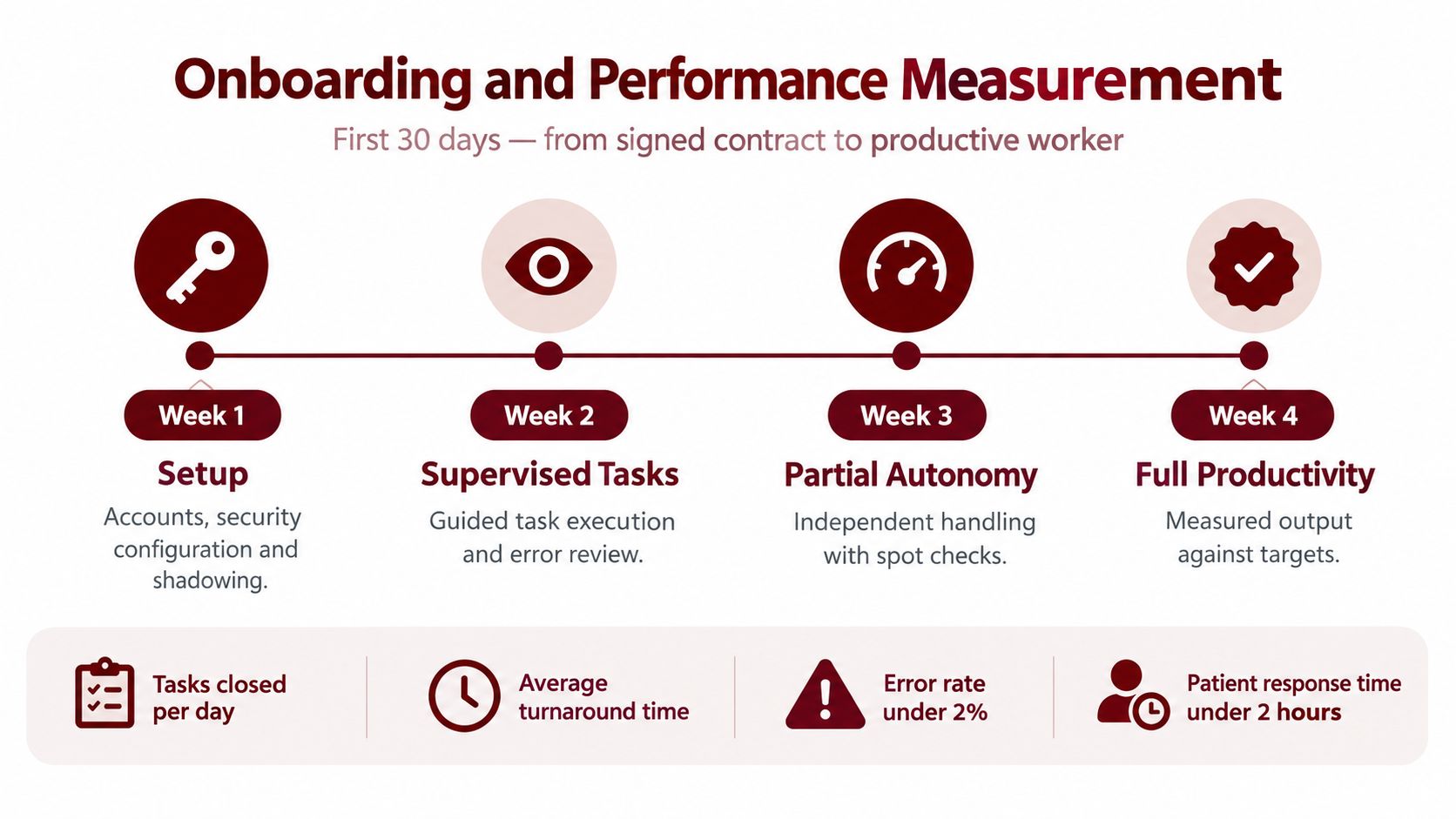
The first 30 days determine whether the hire becomes an asset or an overhead. A controlled onboarding plan gives the assistant enough structure to succeed without handing over the whole practice at once.
Run a staged 30-day rollout
Week one should focus on accounts, security setup, workflow shadowing, and written SOP review. The assistant should not be improvising yet. They should be learning the queue structure, the escalation paths, the documentation standard, and the exact tools used for handoffs.
Week two should move into supervised execution. Let them handle a narrow set of tasks while you or a lead staffer reviews the work daily. That's the point where you catch bad habits, especially around routing, note quality, and when to escalate.
Weeks three and four can widen autonomy, but only on the task set they've already handled correctly under review. A limited permission model pays off here. The assistant earns more responsibility by showing accuracy, not by asking for it.
A useful onboarding checklist looks like this:
- Security setup: unique account, MFA, device confirmation, password standards.
- Workflow shadowing: observe before acting.
- SOP training: scheduling, messaging, referral, and documentation rules.
- Escalation drill: practice what to do with urgent, missing, or unclear items.
- Audit review: confirm work quality with random spot checks.
Measure the pilot against a baseline
Use a two-week baseline before the pilot starts, then compare a 30-day pilot using the same definitions. Track first-touch resolution, median turnaround time, error or rework rate, escalation accuracy, abandoned requests, and clinician minutes saved per completed case. If you don't define those terms upfront, the results won't mean much later.
The review cadence should be weekly during the first month, then biweekly after that. Pull a random sample of work and check for clinical-safety errors, missing escalation, or documentation drift. Don't trust vendor claims without a denominator. Case studies that cite dramatic inbox reductions or faster portal turnaround may describe one client, one system, or one specially tuned workflow, not your practice.
For workflow discipline and repeatable operations, Process Street is a useful model for how structured checklists support execution without turning every task into tribal knowledge.
Common Pitfalls and Final Recommendations
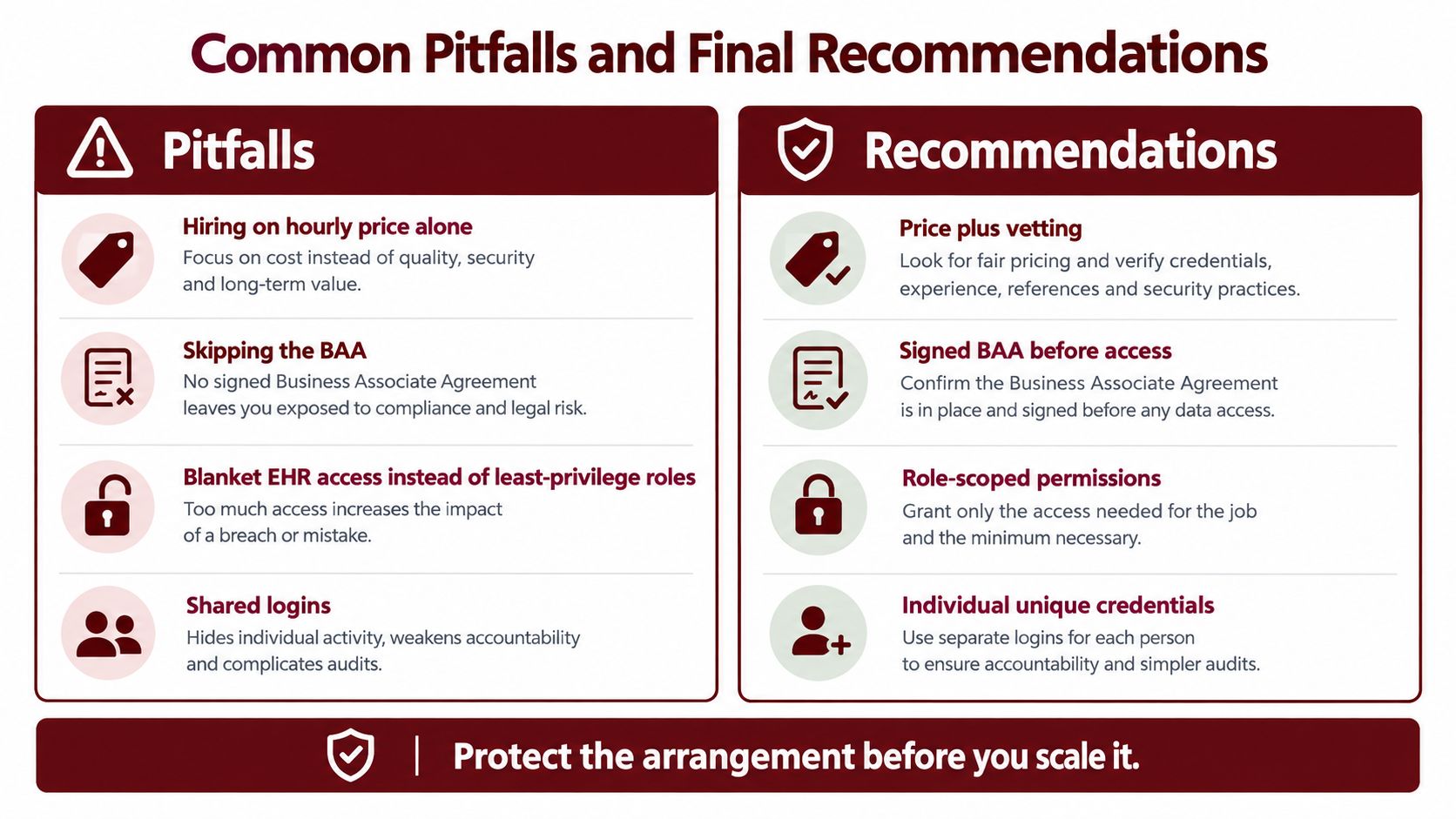
The biggest mistakes are usually the simplest ones. Practices hire on hourly price alone, skip the BAA, give blanket EHR access instead of role-scoped permissions, allow shared credentials, and then wonder why the arrangement feels messy or risky.
What goes wrong most often
The first failure is treating HIPAA training as a box to check once. Training matters, but without access controls, audit logs, and offboarding proof, it doesn't protect much. The second failure is letting the assistant drift into independent clinical judgment because they're “good with patients” and seem capable.
The staffing context matters too. AMA reporting notes that nearly half of surveyed physicians worked with an incompletely staffed team more than one-quarter of the time, and those physicians were more than twice as likely to report burnout AMA staffing and burnout data. That's exactly why a good medical VA can help, but only if the practice keeps the role narrow and controlled.
Use a simple go-forward sequence
Start with the workflow inventory. Write the scope, identify the ePHI touchpoints, and build the pre-access controls before interviews begin. Then screen with a queue simulation, not a résumé review, and only after that decide on pricing and contract terms.
If you want the arrangement to survive past the first month, keep the structure tight:
- Define the work: one-page scope, excluded tasks, escalation rules.
- Control the access: named accounts, MFA, least privilege, logging.
- Prove the fit: simulated queue test, reference checks, workflow literacy.
- Measure the output: baseline, pilot, KPI review, random audit.
- Remove access cleanly: written offboarding with immediate revocation.
The right medical VA doesn't just take tasks off the desk. They fit into a controlled operating model that protects patient data and returns time to clinicians. If you're ready to hire medical virtual assistant support, turn the role definition into a checklist, run the pilot with metrics, and use the controls as seriously as you use the interview. If you want a place to share the finished role and compare it with other launches and workflow tools, Sidehunt is a practical next stop for getting the project in front of early adopters.